BYTE x CCCC 2026: Reimagining the Teaching Philosophy Statement
Earlier this month, I had the opportunity to co-lead a half-day workshop at the Conference on College Composition and Communication with my collaborator Dr. Miranda Rodak. Together, we facilitated Leveraging Creative Design Tools to Tell the Story of Your Teaching Philosophy, a session grounded in our Branding Your Teaching Excellence (BYTE) framework.
At its core, the workshop invited participants to reconsider a familiar and often anxiety-inducing genre: the teaching philosophy statement. What if this document didn’t have to feel static or formulaic? What if it could instead function as a creative, reflective articulation of their professional identity?
Take it from one participant: “Crafting a teaching philosophy statement doesn’t have to be a scary enterprise. If you give yourself the space to get creative, it can help you build a professional identity in an empowering way.” That insight gets at the heart of BYTE.
Too often, teaching philosophy statements are written under pressure, reduced to a set of expected moves that flatten the complexity of what we do. When we begin to approach them as stories about our teaching—stories with values and stakes—they become not just more compelling, but more clarifying about who we are and why we do what we do.
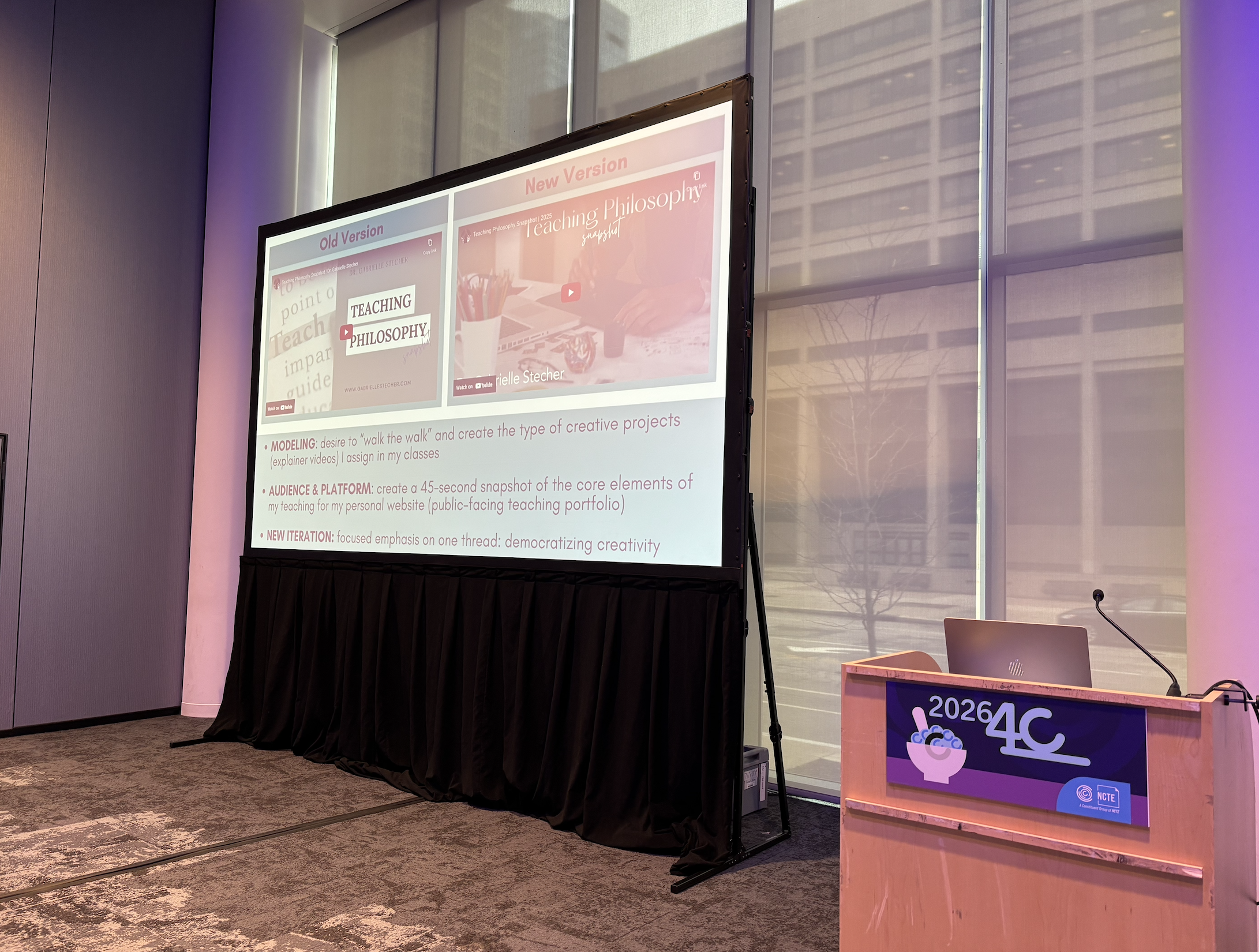
Demonstrating my own remediated teaching philosophy statement video for my website
After surveying sample statements and discussing revision priorities, we asked participants to “walk the walk” by engaging directly with creative platforms like Canva and Adobe Express. Participants began remediating their teaching philosophy statements into engaging, multimodal artifacts for public consumption. This process did more than inspire dynamic portfolio materials; it helped faculty see new connections across their teaching practices and articulate the narrative arc of their pedagogical development for diverse audiences. Design, in this sense, became a mode of thinking as much as a mode of presentation.
The teaching philosophy is not simply a static document, but a living one that evolves alongside our work. Multimodal design, far from being an add-on, can sharpen our understanding of our own teaching by making abstract values visible and concrete. Just as importantly, when faculty engage the same digital tools we often assign to students, we deepen our awareness of what we are asking them to do and model how those tools can be used for professional, reflective purposes. In a moment when teaching excellence must often be communicated across multiple audiences—hiring committees, award panels, and increasingly public-facing platforms—the ability to translate our work effectively matters.